
Five Tips to Help You Write in 2026

Five Tips to Help You Write in 2026
Happy New Year! As 2026 begins, writers often make New Year’s resolutions to spur their writing to new heights. However, according to a study conducted by Forbes in 2024, people are most likely to give up on their resolutions within the first 2-3 months of the year. It’s easy to get discouraged by your goals as the year passes by, the fresh exciting feeling of January fading in light of the work in months to come.
But ambitious goals are not inherently the problem; having high ambitions encourages us to work on projects beyond what we think we are capable of. How can you make progress in your writing goals and fight demotivation in 2026? Here are five tips to set your year off right and to eliminate friction in the upcoming months as you work on your next project.
1. Have Clearly Defined Goals
Nothing kills motivation quicker than having unactionable goals. If you set a goal to “write more” in 2026, chances are you will get discouraged. Without clear markers indicating your progress along the way, your goal will lay forgotten by March. Start with an overarching goal for your year, then break it down into actionable steps. “Write a first draft” becomes “write 1000 words a day” or “develop an outline by the end of February.”
 A helpful tool to make your goals actionable is to turn them into word maps. Start with your theme or overhead goal, then branch out into smaller goals. Road map how you’re going to get to where you want to go. Once your goals are broken down into the smallest chunks possible, you have a list of the steps it will take you to get to your destination.
Another benefit of this method is that in moments of frustration, when you feel like you have not made the progress you hoped for, you can look back at your list of things you have finished, and be proud of how far you’ve come.
2. Turn your goals into rhythms
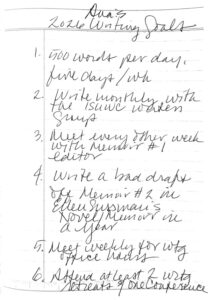
The most successful resolutions carry throughout the entire year. But motivation is quick to wane in the months that follow. How do you stay consistent? Start by outlining your goals from month to month. Once you have your list of actionable steps, assign them to specific months to work on, rather than trying to make 100 changes at once. In January, your focus could just be consistency. For example, writing something every day, regardless of how many words it is or whether it moves your project along. Then in February, take the first of the month as a reset point to re-evaluate your goals and make forward momentum. Like benches on the side of a trail, use the first of the month as a chance to rest and plan for the next stretch of road ahead.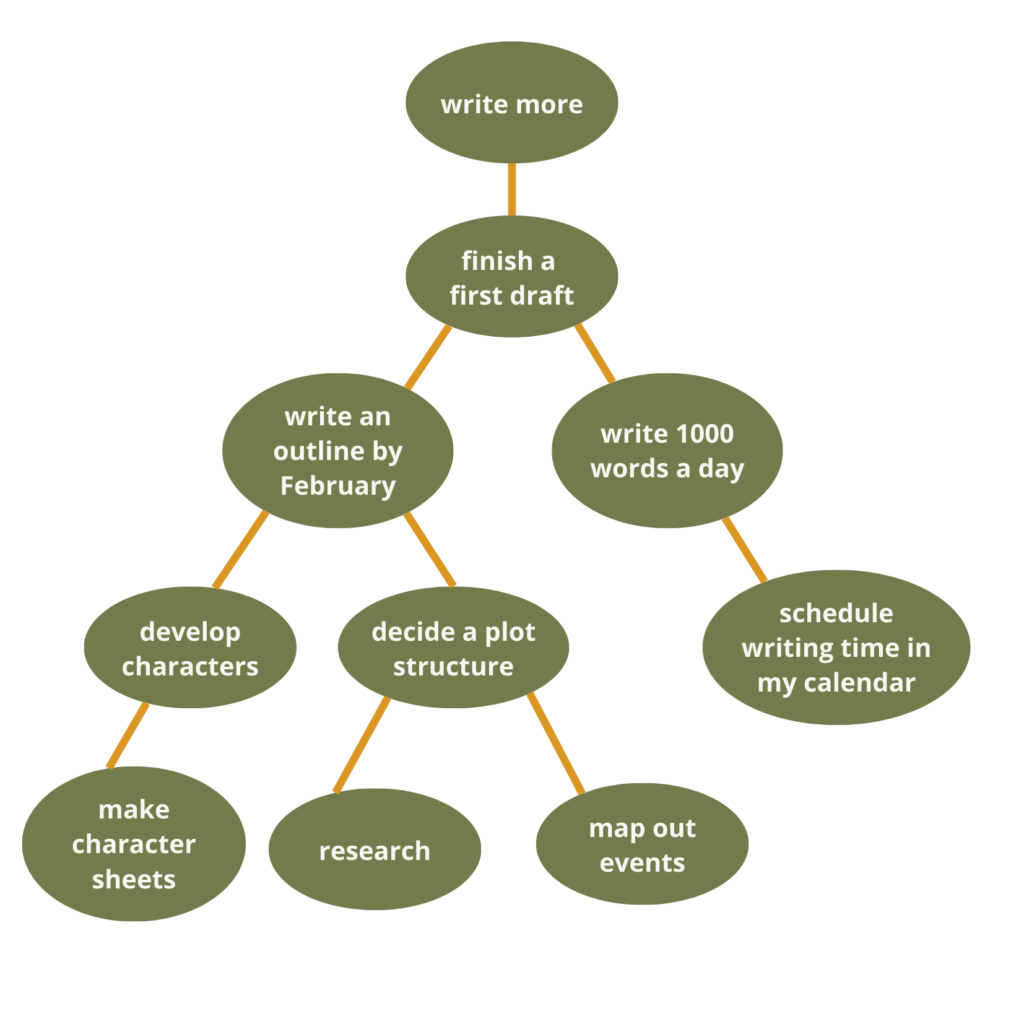
Once you have your monthly goals set, break them down even further into daily rhythms. Routine is key here. Create a time and place that you write, with daily actionable steps. If your goal for the day is “write 500 words,” schedule into your calendar where and when you will be to achieve your goal. Sometimes, in order to combat a lack of motivation, your checklist needs to be divided into smaller and smaller steps. Even if it’s as simple as opening the laptop, opening the document, then write ten words, a small start is better than no start at all. As you schedule writing blocks into weekly routines, don’t forget to schedule in rest days; people aren’t machines and we weren’t designed to run without taking a break every once in a while.
3. Have accountability
According to a 2011 study, group accountability significantly increases motivation and persistence in participants, making it much more likely that those participants achieved their goals. Regular check-ins or creative sessions with other writers can have a huge impact on the progress you make. Finding the right support group is key to forward momentum when passion lags and discipline fails, and you get the added benefit of making friends with other writers along the way.

Here at the Ames Writers Collective, our mission is to create healthy communities through the art of writing. In light of that mission, we offer regular opportunities for writers to come together for generative workshops, group writing sessions, and author talks. We also offer weekly open hours to our members as an opportunity to write in community.
Interested in becoming a member? Click here for more information.
We are always hosting new events for the Ames community. Check out our events calendar!
4. Remember your “why”
When you feel demotivated, remind yourself of why you’re doing this. You’re not writing just to write, you’re writing because you have something you want to say — something you’re passionate about. Whatever that is for you, remind yourself of it regularly. Nothing kills motivation faster than missing out on the point of the work you’re doing.
Have a list of a few things you can do to remind yourself of why you love your craft. Reread a favorite book or poem collection, listen to other authors talk about their love for writing, or make a list of things that would push you to keep moving. But whatever you do, don’t compare your progress to someone else’s. Comparison is the thief of motivation; you set yourself up for feelings of guilt and insufficiency by measuring your writing progress against theirs. Work at a pace and rate which makes sense for you, not for someone else.
5. Master the restart
Perfection is not the goal, progress is. You have to accept that sometimes you are going to fail. It’s not going to be a perfect year, and that’s okay. Failure is a part of growth — it teaches you how to pick yourself back up again when you haven’t touched your project in days, weeks, or even months. By learning the ability to try again, even when you’ve failed, is to learn resilience. Resilience is the ability to recover from tough things. It means being willing to start over again and again and again. It’s knowing that a little progress is better than no progress, and an imperfect start is better than no start at all. Be patient with yourself. When you feel frustrated by the gap between where you are and where your goal is, take a moment to look back and see how far you’ve come from where you started. At the end of the year, you’ll be able to look back at your successes and failures and be grateful for what you learned along the way.


